| INDEXED BY |
|
|
Vol. 1 No. 1 (2025): AMUYA: Indonesian Journal of Management Reviews
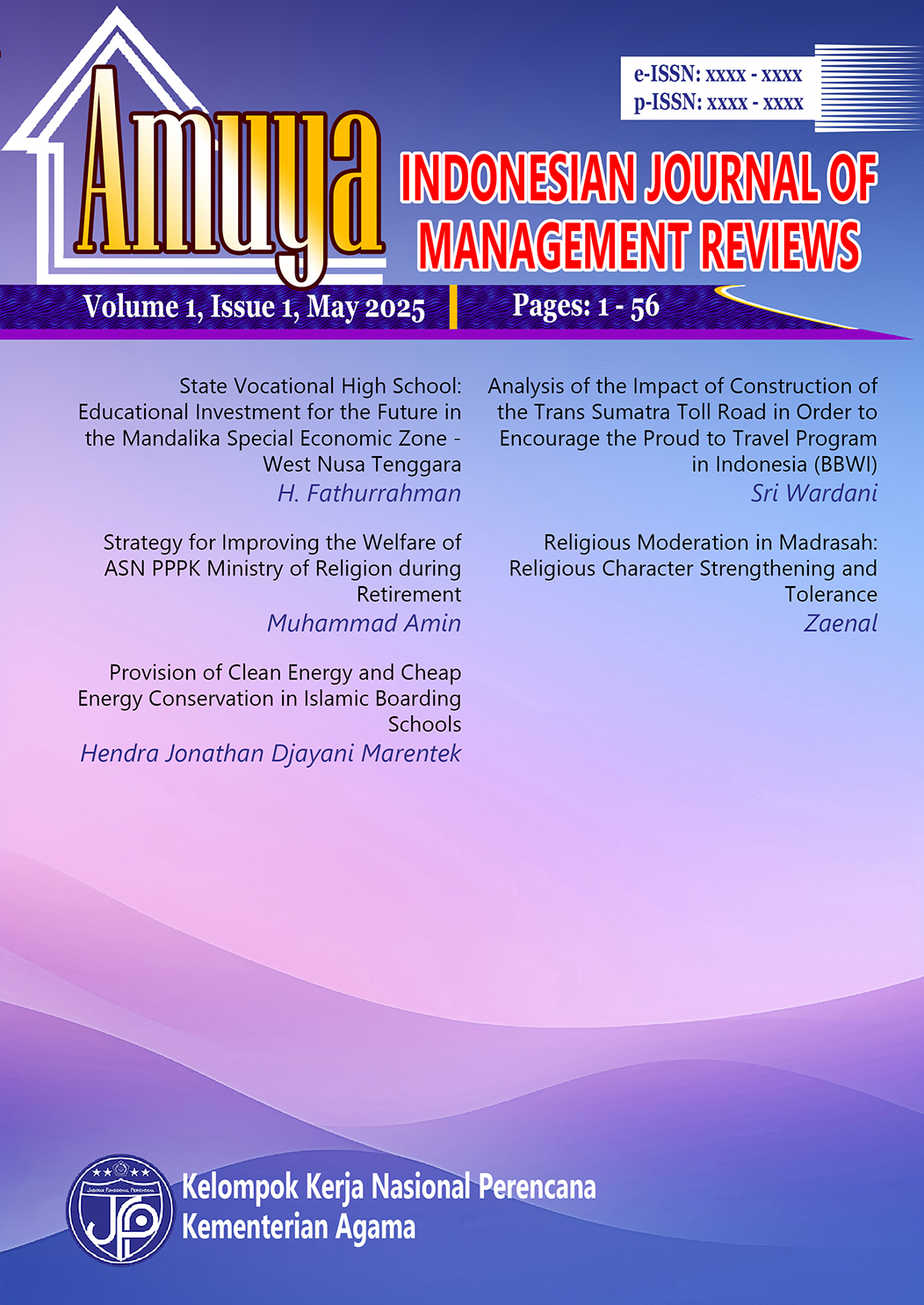
In this inaugural edition, AMUYA: Indonesian Journal of Management Reviews publishes 5 (five) articles, all originating from the Ministry of Religious Affairs of the Republic of Indonesia, as part of the requirements for the application for an e-ISSN (electronic International Standard Serial Number) and p-ISSN (print International Standard Serial Number) to the National Research and Innovation Agency (BRIN) — Directorate of Multimedia Repositories and Scientific Publishing, National ISSN Center of Indonesia.
These five articles are presented according to the scope and focus determined by the Editorial Team of AMUYA: Indonesian Journal of Management Reviews, in the fields of: Decision Sciences (miscellaneous), General Decision Sciences, and Management of Technology and Innovation.
Published:
30-04-2025
Full Issue
Articles
-
State Vocational High School: Educational Investment for the Future in the Mandalika Special Economic Zone - West Nusa Tenggara
Fathurrahman , Samlan
, Abdul Haris Khoirul Alam
Abstract:
This article examines the urgency of establishing a State Vocational Madrasah Aliyah (MAKN) in the Mandalika Special Economic Zone (KEK), West Nusa Tenggara, as a strategic investment in meeting the needs of education and skilled labor in the tourism sector and related industries. The Mandalika KEK, as a super-priority tourism destination, requires competent human resources to support economic growth while still fortifying the "moral-religious" spirit of the local community from the onslaught of various tourist cultures that come one after another. This article uses a qualitative method with a literature study approach, secondary data analysis, and interviews with relevant stakeholders, including local government officials, tourism industry players, and community leaders. The results of the analysis show that the establishment of MAKN with relevant vocational programs, such as hospitality, culinary arts, and tourism, will have a significant positive impact. MAKN is expected to improve the quality of local human resources, create jobs, and encourage the development of small and medium enterprises. In addition, MAKN is also likely to support sustainable development in the area. Support from the local government, the Ministry of Religion, and industry players is a crucial factor in realizing a quality and competitive MAKN. This article concludes that the establishment of MAKN is an important educational investment for the future of Mandalika, in line with the National Long-Term Development Plan (RPJPN) 2025-2045, and recommends a policy of important collaboration between various parties to ensure the success of its implementation.
-
Strategy for Improving the Welfare of ASN PPPK Ministry of Religion during Retirement
Muhammad Amin
, Ibnu Hasan Karbila
, Leni Nopilia
Abstract:This article examines that welfare and placement of retired Government Employees with Work Agreements (PPPK) at the Ministry of Religion. With the enactment of Law Number 20 of 2023, which regulates the rights of ASN, including PPPK, this study aims to evaluate the welfare conditions of PPPK retirees as well as the challenges and opportunities in their placement. The research method used is a case study and documentation analysis. The results of the study indicate that although PPPK are entitled to pension insurance, there are still several obstacles in its implementation, such as a lack of access to health services and training programs. The recommendations from this study are the need to increase pension benefits, provide comprehensive health insurance, and develop training programs to improve the welfare of retired PPPK.
-
Provision of Clean Energy and Cheap Energy Conservation in Islamic Boarding Schools
Hendra Jonathan Djayani Marentek
, Toni Kurnia Jaya
, Ismail Hasan
Abstract:This paper describes that Islamic boarding schools in Indonesia in 2024 will reach 36,600 boarding schools, with a total of 3,642,738 students, which is a potential market share as well as a potential target to be developed into a clean energy manufacturing provider as well as an energy conservation area. On the other hand, the Indonesian Government is trying to increase the portion of the renewable energy mix according to the National Energy Policy (KEN) which will reach 23% in 2025. Islamic boarding schools as one of the centers of educated people are the right place to socialize and implement the New Renewable Energy and Energy Conservation program. The purpose of this study is to calculate the technical feasibility of utilizing communal biogas for cooking, generating rooftop solar power to support the energy diversification program and reduce PLN electricity bills, and replacing LED lamps according to SNI 6197:2011 concerning lighting systems in building structures and supporting energy conservation efforts. The methodology used is a survey and direct measurement related to local solar energy potential, the precision of the PLTS location, electricity needs, biogas potential and its designation, and lighting needs. Data processing was carried out using Meteonom, CorelDraw, and Pvsyt software. The results of the study showed that, for example, the Al Ihsan Islamic Boarding School case, is worthy of being recommended as a pilot project for the program. PP Al Ihsan has a potential for solar radiation of 4.91 kWh/m2.day with an average annual temperature of 27.8 oC so it is feasible to build a rooftop PLTS with a capacity of 13,000 Wp to supply the electricity needs of the boarding school which reaches 15,840 VA. The number of students of PP Al Ihsan which reaches 590 students with a sufficient area makes PP Al Ihsan feasible to build a communal biogas with a scale of 6 m3. In terms of replacing LED lamps, PP Al Ihsan will meet SNI standards by replacing 39 5-watt LED lamps, 89 13-watt LED lamps, and 18 27-watt LED lamps.
-
Analysis of the Impact of Construction of the Trans Sumatra Toll Road in Order to Encourage the Proud to Travel Program in Indonesia (BBWI)
Sri Wardani
, Radiah Sahid
, Fidelia Kirana
Abstract:This paper describes that toll roads are National Strategic Projects (PSN) that are prioritized by the government to improve accessibility and encourage economic growth in a region. Sumatra Island as the second largest island in Indonesia has a variety of natural, commodity and tourism potential. This policy paper outlines an analysis of the impact of the Trans Sumatra Toll road development on the government's Proud to Travel in Indonesia (BBWI) program. The tourism potential of Sumatra Island is not inferior to that of Java Island. It's just that the island's tourist destinations have limited travel distance, few accommodations and lack of promotion. Thus, Sumatran tourists prefer to visit abroad because it is easier, faster and more affordable. The purpose of this policy paper is to explain the results of the analysis of the Trans Sumatra Toll Road that its existence can improve regional tourism and encourage the WWBI program through tourism management strategies in each province on the island of Sumatra. With a qualitative method approach, this policy paper emphasizes data analysis methods through literature studies from various information both books, journals and official government websites, then the results are assembled by providing informational narratives and policy suggestions. Broadly speaking, the results of this policy paper analysis show that the Trans Sumatra toll road provides benefits to accelerate the distribution of goods and services and has a positive impact on tourist visits in the region. The alternative policy to support the BBWI program is to implement city branding for tourist areas on the island of Sumatra, so that tourism promotion increases tourist visits.
-
Religious Moderation in Madrasah: Religious Character Strengthening and Tolerance
Zaenal
, Nasrullah Sulaiman
, Ervy Alinda Lubis
Abstract:This study aims to examine religious moderation in madrasah, focusing on strengthening character and religious tolerance. The study uses a descriptive qualitative research method, with the subjects being students and teachers at one of the madrasas in Indonesia. Data were collected through interviews and observations, then analyzed using descriptive analysis techniques. The results show that madrasas play an important role in teaching religious values and strengthening students' character, as well as developing religious tolerance to foster harmony and diversity in society. Strengthening character in madrasah can be achieved through religious teaching and the development of students' personalities by providing positive examples in daily life. Religious tolerance can be strengthened by teaching Islamic principles that promote tolerance, engaging in social activities together, and interfaith dialogue. However, there are several challenges in strengthening religious moderation in madrasah, such as the lack of available facilities and supporting curricula, as well as discrimination and intolerance in society. Therefore, support from the government and all relevant stakeholders is needed to strengthen educational programs that emphasize values of tolerance and harmony. Overall, this study shows that madrasas can play a role as Islamic educational institutions that can strengthen students' character and develop religious tolerance, thereby helping to build harmony and diversity in society.