| INDEXED BY |
|
|
Vol. 1 No. 2 (2025): AMUYA: Indonesian Journal of Management Reviews
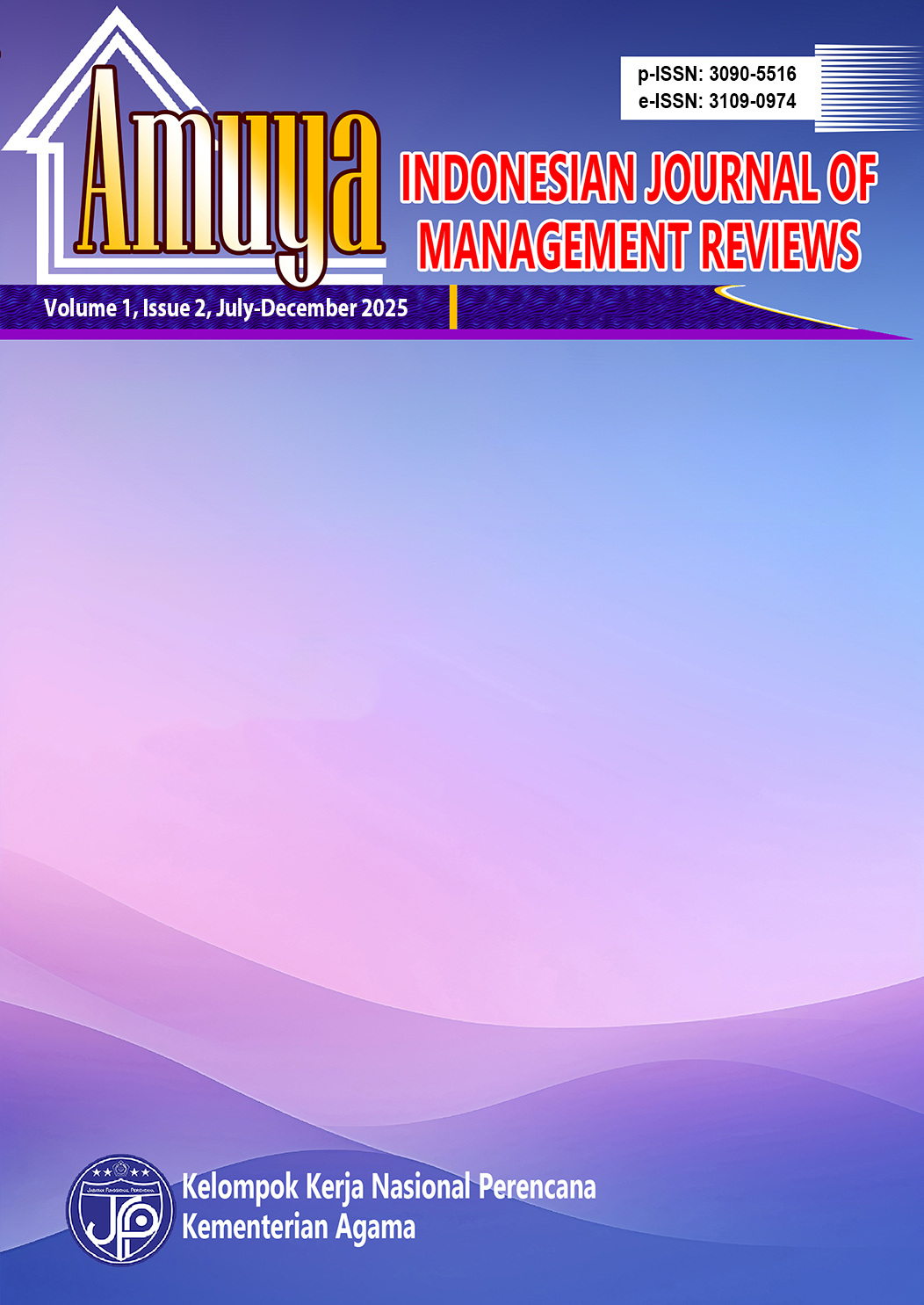
Volume 1 Issue 2, July–December 2025, is a continuation of the publication of the Print ISSN Numbers: 3090-5516 and Electronic: 3109-0974 from the National Research and Innovation Agency (BRIN) — Directorate of Multimedia Repositories and Scientific Publishing, Indonesian National ISSN Center.
The articles published in Volume 1 Number 2, July–December 2025, are derived from policy articles by "Planners" within the Ministry of Religious Affairs of the Republic of Indonesia. These articles have received approval for "passing" the Minimum Work Results (HKM) from the Center for Development, Education, and Training of Planners (Pusbindiklatren) – Bappenas RI, as the main requirement for "Planners" who will take the "Associate Expert" Competency Test.
These policy articles are presented in accordance with the scope and focus determined by the Editorial Team of AMUYA: Indonesian Management Review Journal, in the fields of: Decision Sciences (other), General Decision Sciences, and Technology and Innovation Management.
Published:
06-11-2025
Articles
-
Strategic Analysis of the Need for Policy Strengthening Quality Improvement of Graduates of Syekh Ali Hasan UIN Ahmad Addary Padangsidimpuan
Buyung Saroha Nasution , Mulyono
Abstract:
The problems of UIN Syekh Ali Hasan Ahmad Addary Padangsidimpuan undergraduate graduates are: 1) The ratio of graduate acceptance in the job market is still low, namely 49.97% percent, 2) The waiting period for UIN Syahada Padangsidimpuan students after graduation still exceeds the maximum standard of 6 (six) months. 3) The condition of the integrated laboratory at UIN Syekh Ali Hasan Ahmad Addary Padangsidimpuan is still far from the standard of education services based on Government Regulation Number 57 of 2021 concerning National Education Standards. As a solution to this problem, it is important to improve the quality of facilities, infrastructure and learning at UIN Syahada Padangsidimpuan. The development of laboratory facilities and infrastructure at UIN Syahada is a very important policy in overcoming problems and improving the quality of education in meeting educational service standards at UIN Syahada Padangsidimpuan.
-
Policies and Strategy of the Ministry of Religion in Improving Services as a Response to the Spread of Covid-19 in 2020
Azizah Luthfiah
, Rosmawati
Abstract:The existence of the MORA in governance in Indonesia is very important so that its existence has been present throughout Indonesia with various forms and levels of work units. With regard to the outbreak of the Covid-19 early 2020, all government agencies, both central and regional, at all levels participated in carrying out efforts to handle the pandemic both with strategies and policies, such as refocusing activities, budget reallocation, policy making and appeals related to efforts to prevent and accelerate the handling of the spread of Covid-19. Reflecting on the massive change in the focus of activities and the focus of budgeting that occurred, which was diverted to support the acceleration of handling the pandemic, the object of planning as an activity of making decisions from various choices regarding targets and ways to be implemented in order to achieve the desired goals that are carried out systematically and continuously really needs attention. The purpose of this paper is to evaluate the efficiency of strategic stratetegi and the policy of improving the ministry's services as a response to the outbreak of the Covid-2019 pandemic. The research method used is descriptive analysis.
-
Population Development and Improvement of Education Infrastructure in Riau Province: A Case Study at the Regional Office of the Ministry of Religion in Riau Province
Harmendra
, Hamdi
Abstract:The population growth in Riau Province is increasing every year. This is in contrast to the existing educational infrastructure. Furthermore, the interest of students and parents in continuing education in Madrasah is also increasing. However, the growth rate of madrasah educational units seems to experience stagnation or zero growth. Therefore, this study aims to map the population growth in Riau Province and the available educational infrastructure for madrasah. This is important to achieve equal education as mandated by the law and to support the achievement of the Excellent and Dignified Riau Province Vision 2019-2024. The conclusion of this study provides a recommendation for the Regional Office of the Ministry of Religion in Riau Province to create a program for the establishment of madrasah at the district/city level. Furthermore, the equal distribution of educational infrastructure is also important to be one of the priority policies to achieve the National Education goals effectively.
-
Implemetation of Religious Moderation in the Ministry of Religion South Sulawesi Province
Muhammad Syuja’i
, Mukhtar Alshodiq
Abstract:The rapid flow of information through social media influences the implementation of religious moderation in society, particularly in the office environment. The phenomenon of moderation through social media platforms has become a space for the emergence of various religious issues, which influence each person's perspective on religious matters. The purpose of this paper is to determine the implementation of religious moderation in the office environment, specifically within the Ministry of Religious Affairs in the South Sulawesi province. The method used is descriptive qualitative, with sources gleaned from literature that correlates with the problem. Data collection comes from journals, ebooks, websites, and YouTube. The results and discussion of this paper are: Implementing religious moderation is not enough to be done individually, but must be done systematically and institutionally, even by the state. The state must be present to facilitate the creation of a healthy public space, so that communication between people of different religions and beliefs can be fostered. Providing all facilities and not restricting them is a just and wise moderate attitude. Having a moderate nature for all ASN employees will realize the benefits of religious life and harmony, peace, and tolerance within the nation.
-
The Role of the Madrasah Head in Implementing the Independent Curriculum at the Madrasah
Nurhayati
, Pebri Edy
Abstract:The aim of this policy paper is to find out the role of the Madrasah Head in implementing the Merdeka Curriculum. The research method used is a qualitative, qualitative is a series of procedures designed to produce descriptive data in written or spoken words. The kinds of research are descriptive, that describes about phenomena, events and incidents in certain groups. The results show that; As Madrasah leaders must work together with educators and education staff to improve the quality of education in Madrasah. The role of the madrasa head in implementing the Curriculum merdeka is to encourage a student-centered learning process and allow flexibility for educators and their education staff. In solving problems related to the Problems of implementing the Merdeka Curriculum in Madrasas, the Head of the Madrasah has an active role to answer current problems, related to the implementation of the Merdeka Curriculum effectively and efficiently.
-
The Impact of the Policy for Forming Religious Moderation Villages on Creating Peaceful Conditions in Southeast Sulawesi
Rahmad
, Nasrullah Sulaiman
, Muh. Yahya
Abstract:This study examines the implementation of the Religious Moderation Village (KMB) policy in Southeast Sulawesi Province as a response to digital disruption that threatens credible religious authority and trigger identity polarization. Amidst the contestation of digital spaces dominated by exclusive narratives and provocative hoaxes, the role of Islamic Religious Counselors is crucial as information mediators and agents of moderation. The main focus of this study is to evaluate the impact of the KMB policy in creating peaceful conditions and how the transmission of moderation values is carried out in digital and non-digital contexts. The research methodology used is descriptive qualitative with a policy study approach. Data were collected through in-depth interviews with Islamic Religious Counselors and community leaders in the KMB area, participant observation of counseling activities, and content analysis on social media channels (Facebook, Instagram, YouTube, and TikTok) to measure the effectiveness of counter-narratives against extremist ideologies. The analytical framework uses Heidi Campbell's Religious-Social Shaping of Technology theory to dissect the shift in religious authority in the digital era. The research findings show that the establishment of the KMB in Southeast Sulawesi significantly strengthened social capital and the resilience of rural communities to asymmetric information. Religious instructors play a strategic role in enhancing the community's digital literacy to filter out misleading "buffet of religious narratives." This study recommends strengthening digital literacy for instructors to enable them to seize the digital stage through inclusive and tolerant narratives. Integrating Southeast Sulawesi's local wisdom with digital transformation is key to successfully creating a moderate, stable, and harmonious religious ecosystem at the grassroots level.
-
Policy Strategy for Supporting Marriage Counseling in Reducing Divorce Trends
I Putu Putra Yasa
, Trisula
, Hamdan Tajori
Abstract:This policy paper outlines that the increasing divorce rate in Indonesia indicates the need for more effective policies to support family resilience. One factor contributing to this trend is the low level of awareness among couples about accessing marriage counseling. In developed countries, counseling is a normal part of married life, while in Indonesia, social stigma still hinders this. This paper analyzes this issue and the policies that can be implemented to normalize marriage counseling in Indonesia. The purpose of this policy paper is to formulate comprehensive policy recommendations to address the issues of marriage counseling support and communication, which are the root causes of divorce. A qualitative approach was chosen, emphasizing the U-Process analysis method. The results indicate that couples' awareness of accessing marriage counseling remains low. Individual mental models of each actor can be a barrier to accessing marriage counseling. The potential of religious and cultural leaders has not been fully utilized. Policy recommendations are directed to the Minister of Religious Affairs, religious and cultural leaders, and relevant institutions to support the normalization of marriage counseling through religious and cultural leaders. This approach is expected to create a paradigm shift in society that will be more open to marriage counseling. Marriage counseling becomes a necessity, not just a solution to conflict. This will strengthen family resilience, improve the quality of communication within the household, and reduce the divorce rate in Indonesia.
-
Artificial Intelligence Based Pre-Marital Counselling Policy in Forming a Sakinah Family
Muhammad Sofyansah
, Rahmatullah
, Hildan Latif
Abstract:This policy paper describes the policy of pre-marital counselling guidance based on artificial intelligence (AI) in forming a sakinah family. The purpose of this study is to analyse the implementation of an Artificial Intelligence (AI)-based pre-marital counselling policy as an innovative solution in preparing prospective married couples to form a sakinah family. The research also aims to identify the role of AI technology in detecting and preventing the main factors that cause divorce, such as disputes, arguments and economic problems, through the pre-marital counselling programme. This research uses descriptive qualitative methods to understand phenomena related to pre-marital counselling, the use of artificial intelligence (AI), and the formation of a sakinah family. Data sources consisted of primary data obtained through in-depth interviews with 15 respondents, and secondary data obtained from documentation studies, such as scientific literature and related policies. Data collection techniques included semi-structured interviews and documentation studies. The data analysis technique uses Miles and Huberman's interactive analysis model, which includes three stages: data condensation, data presentation, and conclusion drawing. This policy paper reveals that a policy that integrates AI in pre-marital counselling guidance with several concrete steps. Firstly, it is important for the government or relevant institutions to develop an AI-based digital platform that is easily accessible to prospective couples across Indonesia, with interactive features such as a chatbot for direct consultation. Second, the guidance programme should be tailored to the personal needs of each couple, by utilising AI algorithms that can assess and provide recommendations according to the couple's character and situation. Third, there needs to be continuous monitoring and evaluation of the effectiveness of the use of AI in this guidance, to ensure the quality of service remains optimal.
-
Strengthening Cash Waqf Literacy through National Regulations for Economic Empowerment
Ahmad Shobri
Abstract:This policy paper describes that cash waqf is a potential Islamic philanthropic instrument to support community development and sustainable economic empowerment. However, its implementation in Indonesia still faces major challenges, particularly the low level of public understanding, limited capacity of nazir (waqf managers), and the lack of technical re gulations and fiscal incentives. A survey by the Indonesian Waqf Board (BWI, 2023) shows that only about 23% of the population understands the concept of cash waqf. This condition hampers the optimal utilization of cash waqf to support national development agendas, including the Ministry of Religious Affairs' Strategic Plan 2025–2029 and the Sustainable Development Goals (SDGs). This study applies a qualitative approach through document analysis, literature review, and comparison with international practices in Malaysia and Turkey. The analysis employs theories of Islamic financial literacy, institutional theory, and trust theory in Islamic philanthropy. The findings indicate that improving public literacy is the most urgent policy to implement, as it serves as the entry point for strengthening nazir capacity and regulatory reform. The main recommendation is the establishment of a Ministerial Regulation (PMA) on Cash Waqf Literacy, covering curriculum integration, digital literacy campaigns, involvement of mosques and Islamic organizations, and national evaluation mechanisms. This policy is expected to increase public understanding to at least 50% by 2029, expand the number of waqf donors, strengthen nazir capacity, and position cash waqf as a sustainable financing instrument for community economic development.
-
Reformulating Mission-Based Performance Indicators: A Policy Alternative for Performance-Based Budgeting in Religious Higher Education
Abstract:This study analyzes the fundamental issues in the implementation of performance-based budgeting policy at the State Islamic University (UIN) Imam Bonjol Padang. Although the policy aims to increase efficiency, its application creates a misalignment between uniform government performance indicators and UIN’s unique mission as a religious educational institution. The research identifies the main root causes: (1) a lack of institutional policy to align performance indicators, (2) a one-size-fits-all policy approach, and (3) demands for bureaucratic and administrative efficiency. This paper uses a qualitative method with a descriptive analysis approach, USG analysis, and William N. Dunn's theory. The findings show that a regulative alternative is the most effective solution to address the root problems directly and quickly. As a recommendation, this article advises the Rector to issue new guidelines for implementing performance-based budgeting at UIN Imam Bonjol Padang, prioritizing the development of diverse and contextual performance indicators as a first step. This strategy directly addresses the core issue in performance-based budgeting: the misalignment of uniform indicators with the unique characteristics of each faculty and work unit.
-
UIN Maulana Malik Ibrahim Malang's Strategic Policy in Encouraging Local Economic Collaboration
Fitria Amalia Dewi
Abstract:This policy paper analyzes the policy issues related to the weak collaboration between UIN Maulana Malik Ibrahim Malang and local economic stakeholders, which has resulted in limited community economic empowerment. Using qualitative methods and a comprehensive policy analysis approach, this policy paper identifies the root cause: the absence of a formal mechanism regulated by the university's internal regulations to integrate input from MSMEs, industry, and local government. This gap results in curriculum irrelevance to job market needs, underutilization of academic innovation, and a lack of practical skills for graduates. Using USG (Urgency, Seriousness, Growth) analysis and policy alternative criteria scoring theory, this article highlights the urgency of this issue and the need for systemic intervention. The results suggest that the most effective policy alternative is the establishment of a permanent multi-actor curriculum partnership forum, as stipulated in the Rector's Regulation. This forum will serve as a formal bridge to ensure the curriculum and innovation programs remain relevant to local economic dynamics. These policy recommendations are expected to strengthen the synergy between UIN Malang and the surrounding economic ecosystem, thereby increasing the university's tangible contribution to sustainable regional development.
-
Green Waqf Optimization Strategy in Supporting SDGs and the Ministry of Religious Affairs' Strategic Plan 2025-2029
Raino Wiwoho
Abstract:This policy paper describes that waqf is one of the Islamic philanthropic instruments with significant potential to support sustainable development. However, in Indonesia, waqf practices are still dominated by traditional models such as the construction of mosques, pesantren, and cemeteries. This indicates a gap between the ideal potential of waqf as a productive instrument and the current reality of its underutilized management. This study aims to analyze strategies for optimizing Green Waqf as an environmentally friendly financing instrument aligned with the Sustainable Development Goals (SDGs) and the Strategic Plan of the Ministry of Religious Affairs 2025–2029. The methodology used is a qualitative approach through literature review, regulatory analysis, and limited interviews with stakeholders. Analysis was carried out using a fishbone diagram to identify root causes and the USG method (Urgency, Seriousness, Growth) to prioritize problems. The findings show that low public literacy is the root problem, leading to limited nazir capacity and a lack of program innovation. The discussion reveals that without public literacy, the contribution of waqf to sustainable development will remain insignificant. This study offers three policy alternatives: (1) public literacy programs, (2) strengthening regulation and incentives, and (3) multi-stakeholder collaboration. The conclusion indicates that a Ministerial Regulation on Green Waqf is the most strategic policy option. The recommendation is addressed to the Ministry of Religious Affairs to formulate derivative regulations on Green Waqf so that it can contribute significantly to achieving the SDGs and the Ministry’s Strategic Plan 2025–2029.
-
Strengthening Madrasah Fortresses by Enforcing Religious Moderation as a Professional Standard for Teachers
Abstract:Madrasahs, envisioned as bastions of national values, face a critical challenge in implementing religious moderation in Jambi Province. A significant gap exists between national policy mandates and on-the-ground realities, rooted in the low competency and wide disparity in teachers' understanding. Data from the 2022 Competency Assessment (CAT) reveals that over 31% of teachers have 'Poor' or 'Very Poor' comprehension, creating an institutional vulnerability that transforms madrasahs into environments susceptible to intolerant narratives. This study employs a qualitative policy analysis method. The problem was analyzed using secondary data and prioritized with the USG (Urgency, Seriousness, Growth) method. Policy alternatives were evaluated using William N. Dunn's effectiveness criteria to produce a strategic recommendation. The findings indicate that the core problem is structural: religious moderation competency has not been integrated as a measurable professional performance standard within the Teacher Performance Appraisal (PKG) system and academic supervision. Consequently, the most effective and efficient intervention is to revitalize the existing system. It is recommended that the Head of the Jambi Provincial Office of the Ministry of Religious Affairs issue a Circular Letter and Technical Guidelines to integrate practical indicators of religious moderation into the PKG and supervision instruments. This measure fundamentally shifts religious moderation from a moral appeal to a mandatory, evaluable, and accountable professional standard, thereby reinforcing the role of madrasahs as epicenters for nurturing moderate and inclusive national values.
-
Relevance of the Ministry of Religious Affairs' Religious Education Curriculum: Analysis of Knowledge, Skills, and Policy Implementation Gaps
Dwi Agustiningsih
Abstract:This policy paper aims to analyze the gap between the religious education curriculum implemented by the Ministry of Religious Affairs and the knowledge and skills needs of students in the digital era. The background of this problem is the lack of relevance of the curriculum to current developments that require students to have digital literacy, critical thinking skills, and multicultural understanding. The research method used is a qualitative approach with case studies in several madrasahs and public schools in Indonesia, involving in-depth interviews with teachers, students, and policymakers, as well as analysis of curriculum documents. The results of the study indicate a significant gap, where teaching materials tend to focus on theoretical aspects and memorization, while practical skills and the implementation of religious values in daily life are still minimal. Further discussion highlights that the implementation of curriculum policies is often hampered by a lack of teacher training, inadequate supporting facilities, and resistance to change. The conclusion of this study is that the current religious education curriculum requires substantial reform to be more relevant and adaptive to contemporary challenges. Recommendations include developing a competency-based curriculum, strengthening teacher training programs, integrating technology into learning, and developing more participatory policies.
-
Towards a Targeted Smart Indonesia Card (KIP): Policy Strategies for Improving Scholarship Governance in Madrasas and Islamic Boarding Schools
Munfa'ati
Abstract:This policy paper identifies and analyzes the governance issues of the Smart Indonesia Card (KIP) scholarship program at the Ministry of Religious Affairs. The primary issue is the lack of program optimization due to data inaccuracy, complex procedures, and weak coordination. These problems are rooted in a lack of data integration, unclear regulations, and weak socialization, resulting in misdirected scholarships and hampering the program's primary objectives. This paper uses a qualitative method with an ex-post policy analysis approach that examines existing policies. The conceptual framework is developed through a cause-and-effect analysis using the USG (Urgency, Seriousness, Growth) theory to prioritize problems, followed by identifying root causes. Five policy alternatives are then evaluated using the William N. Dunn scoring matrix to determine the most effective solution. The analysis results indicate that implementing a data-driven performance incentive and disincentive policy is the best alternative. Therefore, the proposed policy recommendation is the establishment of a Ministerial Regulation governing the mechanism for providing incentives and disincentives to encourage improvements in data quality and bureaucratic efficiency at all levels, from the central government to educational units. Implementation of this policy is expected to make KIP within the Ministry of Religious Affairs more targeted, equitable, and accountable.
-
Building a Cyber Foundation: A Strategic Policy for Improving the Quality of Digital Learning at UIN Siber Syekh Nurjati Cirebon
Deding Sudarso
Abstract:This policy paper examines the urgency and strategies for improving the quality of digital learning at UIN Siber Syekh Nurjati Cirebon. In line with the global educational transformation, UIN Siber has great potential to become a leading technology-based institution. However, this success depends heavily on a solid cyber foundation, encompassing infrastructure, human resources, and well-planned policies. This paper analyzes the current state of digital learning, identifying key challenges such as access gaps, limited faculty capacity, and content standardization. The approach used is a comprehensive literature review and qualitative policy analysis, which formulates a strategic framework to address these challenges. The analysis results indicate the need for an integrated policy encompassing three main pillars: strengthening information technology infrastructure, developing human resource (HR) capacity through intensive training, and developing relevant and interactive digital curricula and content. Furthermore, this article proposes a continuous monitoring and evaluation system to ensure effective implementation. By implementing this strategy, it is hoped that UIN Siber Syekh Nurjati Cirebon will be able to create an adaptive, innovative, and globally competitive learning environment, making digital learning not merely an alternative but a core part of the vision of future education.
-
Bridging the Gap: Policy Strategies to Align UIN Salatiga Research with Regional Needs
Yusuf Ismail
Abstract:This policy paper describes that low utilization of UIN Salatiga's outputs by industry, society, and government is a pressing challenge that creates a gap between academic research and practical implementation. This phenomenon is rooted in a lecturer performance evaluation system that tends to be quantitative and publication-oriented, rather than focused on real impact. As a result, many high-quality research results remain merely theoretical documents, without making significant contributions to development or solving problems in the field. This policy article aims to comprehensively analyze this issue. The writing method used is qualitative policy analysis, with a diagnostic and prescriptive approach. The initial step is to identify the issue by formulating the problem, its causes, and its consequences based on secondary data and relevant theoretical frameworks, such as Agency Theory and the Goal Substitution Concept. Next, an analysis of policy alternatives is conducted to identify feasible and effective intervention options, using the William N. Dunn scoring method. This analysis yields a single recommendation, deemed the most optimal, namely a revision of the university's internal regulations. This recommendation focuses on changes to the incentive system, which are then formulated into specific policy proposals addressed to key stakeholders. The overall process aims to provide practical and theoretical guidance for transforming the research ecosystem at UIN Salatiga.
-
Empowerment of Business Development Centers of State Islamic Religious Universities: Recommendations for Functional Autonomy and Strategic Partnership Policies
Zikrawahyu
Abstract:This policy paper analyzes the failure of the Business Development Center (Pusbis) of the State Islamic Religious College (PTKIN) as a Public Service Agency (BLU) to optimize non-academic revenue, a crucial issue for the institution's financial independence. The analysis indicates that the primary root cause is regulations that are not adaptive to market dynamics and tend to focus on administrative control rather than commercial efficiency. This is exacerbated by a risk-averse institutional culture and limited functional autonomy. The approach used is a systematic policy problem analysis to identify root causes and their implications. Identified problems are prioritized using the Urgency, Seriousness, Growth (USG) framework, which confirms that irrelevant regulations are the most pressing issue. Next, three policy alternatives—the issuance of a Ministerial Regulation (PMA) on Strategic Partnerships, a Rector's Decree on Functional Autonomy, and a Rector's Decree on Asset Utilization—are comparatively evaluated. This assessment is conducted using William N. Dunn's scoring of policy alternatives based on the criteria of effectiveness, efficiency, adequacy, equity, and responsiveness. The results indicate that the issuance of a PMA on Strategic Partnerships is the most effective alternative. This policy is recommended to provide a clear legal umbrella, simplify bureaucracy, and facilitate productive collaboration that will ultimately empower Pusbis and accelerate the achievement of financial independence of PTKIN.
-
Realizing a Globally Competitive Campus: Centralized Procurement Policy for Digital Infrastructure UIN Siber Syekh Nurjati Cirebon
Nining Suryaningsih
Abstract:This policy paper examines the urgency of transforming the digital infrastructure procurement model at UIN Siber Syekh Nurjati Cirebon as a strategic step towards realizing the vision of a globally competitive campus. The current fragmented and decentralized procurement system across each work unit has created various serious challenges, including budget inefficiency, lack of technology standardization, increased cybersecurity risks, and obstacles to system integration. This situation significantly slows the pace of campus digitalization and hinders the achievement of institutional goals. Through a comprehensive analysis of existing problems, this draft proposes a centralized procurement policy as a fundamental solution. Recommendations include the formation of an integrated procurement team, the development of a technology master plan, the implementation of an e-procurement system, and the strengthening of human resource capacity. This policy aims to optimize budget utilization, ensure technological consistency and interoperability, strengthen cyber defenses, and accelerate the innovation process. Implementing this policy will not only address the weaknesses of the existing system but also build a solid, integrated, and sustainable foundation for the university's entire digital ecosystem. The results are expected to improve the effectiveness of academic and administrative services, support global collaboration, and strengthen UIN Siber Syekh Nurjati Cirebon's position as a modern and superior cyber campus.
-
Harmonizing Policy and Needs: Encouraging Autonomy of State Islamic Religious Universities for Responsive Student Admission Policies in the Regions
Witri Puji Astuti
Abstract:This policy paper presents a policy analysis of the challenges faced by State Islamic Religious Colleges (PTKIN) in the regions due to the centralized national student admissions policy. The main argument put forward is that this one-size-fits-all approach has created a significant gap between centrally-made policies and real needs at the local level, thus hampering PTKIN's strategic role as agents of regional development. This paper adopts William N. Dunn's policy analysis framework, which begins with the identification of relevant policy issues. The main issue, "Policy Mismatch with Local Needs," is analyzed through theoretical and conceptual approaches such as the Centralization-Decentralization Theory, the Policy Gap Theory, and the concept of Responsive Governance. This analysis is supported by a review of related regulatory documents, including Laws and Ministerial Regulations. Based on the root cause diagnosis, this article proposes five policy alternatives in the form of regulations, which are then evaluated using Dunn's alternative scoring to determine their feasibility and effectiveness. The analysis shows that revising the regulations to provide greater autonomy to PTKIN is the most effective solution. The proposed policy recommendation is for the Director General of Islamic Education to mandate regulatory changes that provide PTKIN with flexibility in setting selection criteria and admission quotas. In conclusion, harmonizing policies and needs through decentralization will ensure a fairer higher education system that is more responsive to local development dynamics.
-
Mainstreaming Ecotheology: Designing Responsive Program Policies at the South Sulawesi Province Regional Office of the Ministry of Religious Affairs
Mulvi Affan Husain
Abstract:This policy paper analyzes why the ecotheological crisis at the South Sulawesi Regional Office of the Ministry of Religious Affairs has not received serious attention, creating a gap between the Minister of Religious Affairs' national priority programs and regional policy implementation in the face of tangible environmental challenges. This study aims to deeply analyze the root causes of this failure and formulate systemic and responsive policy recommendations. Using a qualitative, descriptive-analytical approach, this paper is based on the analysis of policy documents (Strategic Plans, Performance Reports), related regulations, and in-depth interviews with key informants. The findings show that the absence of an integrated ecotheology framework is not a technical oversight but a systemic failure rooted in three main problems: (1) an unresponsive agenda-setting mechanism for new issues; (2) a rigid, formalistic, and top-down planning process; and (3) the dominance of an anthropocentric jurisprudential paradigm within the bureaucratic culture. Analysis using public policy theories such as the Multiple Streams Framework, Bureaucratic Politics Model, and Advocacy Coalition Framework further clarifies that this problem is a combination of bureaucratic pathology, internal power struggles, and an outdated belief system. Therefore, piecemeal solutions will be ineffective. This study recommends a fundamental policy intervention: the issuance of a Ministerial Regulation (PMA) on the Mainstreaming of Ecotheology. This regulation is proposed as a strategic solution to create a binding legal mandate, overhaul the planning process to be more participatory, and ensure that regional religious programs become relevant, contextual, and impactful in responding to the ecological crisis.
-
A Path to Job-Ready Graduates: The Urgency of Curriculum Regulation to Overcome the Competency Gap at State Islamic University (UIN) Jurai Siwo Lampung
Abstract:This policy paper addresses the urgent need for curriculum reform to bridge the competency gap among graduates of State Islamic University (UIN) Jurai Siwo Lampung. The core issue lies in the misalignment between graduate profiles and the demands of the modern job market, stemming from a lack of a data-driven evaluation mechanism, minimal collaboration with the private sector, and a slow bureaucratic process. This paper utilizes a qualitative methodology and a systemic approach, beginning with a causal analysis to map the root problems, followed by the formulation and analysis of five strategic policy alternatives. These alternatives are crafted as formal regulations, such as ministerial decrees and circulars, to ensure their binding and sustainable implementation. A comparative analysis utilizing a structured scoring method was then applied to identify the most effective policy alternative. The findings suggest that the optimal solution is a regulation mandating the implementation of an integrated data management system and the decentralization of curriculum change authority. The recommendations aim to provide practical guidance for policymakers at both the university level and the Directorate General of Islamic Education of the Ministry of Religious Affairs. It is anticipated that implementing this policy will transform UIN Jurai Siwo Lampung into an institution that is responsive to industry dynamics, thereby enhancing graduate employability in the job market and optimizing the contribution of Islamic higher education to national human capital development.
-
Private Madrasah Quality Improvement Strategy: Competency-Based Madrasah Principal Selection Policy at the Ministry of Religious Affairs
Ika Shohihah
Abstract:This policy paper describes that low quality of student achievement in private Islamic schools is a serious problem rooted in the low quality of leadership of the principals. This policy analysis identifies that the problem is caused by recruitment and assignment processes that are not competency-based, as well as weak competency standards for private Islamic school principals. This policy paper uses a qualitative method with a descriptive analysis approach and literature study, integrating data from official reports, scientific journals, and government regulations. The problem analysis is conducted through the USG (Urgency, Seriousness, Growth) framework to prioritize the root causes. Theoretical support is obtained from Transformational Leadership Theory, Human Capital Theory, and Principal-Agent Theory. In addition, conceptual support is based on the Instructional Leadership Concept and the Change Management Concept. Based on this analysis, three alternative regulatory policies are proposed: (1) revision of the Minister of Religious Affairs Regulation number 24 of 2018 which is competency-based in accordance with the provisions of Article 6 paragraph 1, (2) issuance of a decree by the Director General of Islamic Education (Pendis) regulating an independent and transparent selection team, and (3) issuance of technical instructions on a periodic performance evaluation system. These three alternatives are then analyzed using William N. Dunn's scoring theory to determine their feasibility and effectiveness. The analysis results show that the revision of the PMA has the highest score, followed by the issuance of the decree of the Director General of Islamic Education regulating the selection team, which is considered the most effective and worthy solution to be recommended to the Ministry of Religion in an effort to improve the quality of education in private madrasas.
-
The Gap in Access to Marriage Guidance: A Policy Study to Reduce Child Marriage in East Java
Andik Suyitno
Abstract:This policy paper describes that high number of marriage dispensation requests in East Java indicates a systematic failure in protecting children from early marriage. This study aims to comprehensively analyze the causal factors, including: 1) the limited authority of the Office of Religious Affairs (KUA) in stopping child marriage; 2) disparities in access to marriage guidance (Binwin) due to geographical, socio-economic, and educational constraints; and 3) operational limitations of Binwin services, such as a lack of innovation, schedule flexibility, and adequate human resources. This policy paper uses a qualitative methodology with a descriptive analysis approach and literature review. Primary data were collected from various official documents of the Ministry of Religious Affairs, policy paper reports from research institutions, and scientific journal publications relevant to the issues of child marriage, marriage guidance, and public policy. Data analysis was conducted using descriptive-analytical techniques, where the collected data were organized, interpreted, and synthesized to identify patterns, causal relationships, and existing gaps. The results are expected to serve as a basis for formulating alternative policies that focus on strengthening the role of the KUA, improving access and quality of Binwin services through digital innovation, and more inclusive communication strategies. Thus, this study contributes to holistic efforts to reduce child marriage rates and build more resilient families.
-
Digital Literacy and Distributive Justice: Key Issues in ZISWAF Management in South Sulawesi
Muhammad Syujai
Abstract:This policy paper describes that management of Islamic philanthropy, including zakat, infaq, sadaqah, and waqaf (ZISWAF), in South Sulawesi has great potential to reduce poverty and economic inequality; however, its implementation has not yet yielded the best results. The adoption of digital platforms for donations is still low, with most contributions being made through conventional means. This article identifies three main issues that hinder the use of digital ZISWAF in the region: low digital literacy and public trust, limited regulation and inter-agency coordination, and inadequate technological innovation. These issues are interconnected: low digital literacy makes the public hesitant to use digital platforms, while cases of online fraud further erode trust. Furthermore, the lack of specific internal regulations from the Regional Office of the Ministry of Religious Affairs of South Sulawesi has caused digitalization initiatives to be slow and unstructured. Using the USG (Urgency, Seriousness, Growth) analysis method, it was found that the problem of low digital literacy and public trust is the top priority that must be addressed immediately. The proposed solution is to issue a Decree of the Director General of Islamic Community Guidance regarding the Integration of the Digital Philanthropy Literacy Curriculum into Religious Programs. This article analyzes the problem from various theoretical perspectives, including Social Capital Theory (Putnam, 2000), Diffusion of Innovation Theory (Rogers, 2003), Institutional Theory (Scott, 2008), and Distributive Justice Theory (Rawls, 1999). Relevant conceptual and regulatory support is also used to strengthen the argument, affirming that the Ministry of Religious Affairs has a central role as a regulator and facilitator to build a trusted and sustainable digital Islamic philanthropy ecosystem.
-
Development of the Integrity Zone of the Ministry of Religious Affairs Office of Magetan Regency: A Process, Challenges, and Strategies Towards a Corruption-Free Area
Indah Kurniawati
Abstract:This policy paper describes that implementation of Bureaucratic Reform (RB) in several Work Units is often still administrative in nature due to a limited understanding of the substance of the area of change. This condition causes a discrepancy between internal assessments and the reality of public services, so that the objective of establishing an Integrity Zone (ZI) towards a Corruption-Free Zone (WBK) has not been fully achieved. To understand these dynamics, a qualitative method was used with Strengths, Weaknesses, Opportunities, and Threats (SWOT) analysis. The results of the analysis show that the main strengths lie in the formation of the ZI Work Team in the Work Unit, the existence of an internal control mechanism by the Internal Assessment Team (TPI) of the Ministry of Religious Affairs, and the existence of rewards for successfully achieving the WBK predicate. However, weaknesses emerged in the form of low understanding among the State Civil Apparatus (ASN) of the substance of the 6 areas of change and their indicators, and the Evaluation Worksheet (LKE) was only filled out administratively. In terms of opportunities, there are national regulations and policies related to RB and ZI, opportunities to learn from other agencies that have successfully achieved WBK, and developments in information technology that support data openness and public service innovation. Meanwhile, threats come from external oversight by the media or Non-Governmental Organization (NGO), as well as competition in achieving WBK with other work units. In conclusion, the implementation of ZI development at the Magetan District Ministry of Religious Affairs Office has so far been stuck in an administrative approach.
-
Reviewing the Success of the Keluarga Sakinah Program: The Urgency of Evaluation for more Accurate Policies
Rohani Rohani
Abstract:This policy paper evaluates the implementation of the Keluarga Sakinah (Harmonious Family) program, which has not yet optimally achieved its goals due to various policy problems. The main issue identified is the lack of a uniform implementation standard, exacerbated by a weak monitoring and accountability mechanism. This situation stems from the absence of a comprehensive guideline, a standardized curriculum, and clear performance indicators. Methodologically, this study uses a qualitative policy analysis approach, adapting the stages of analysis from William N. Dunn's model. Secondary data from policy documents, academic publications, and government reports were used to identify the problems, analyze their root causes, and evaluate alternative solutions. A USG (Urgency, Seriousness, Growth) analysis was applied to prioritize the issues, while Dunn's alternative scoring was used to select the best solution. The findings indicate that standardizing the curriculum and guidance modules is the most effective alternative. Therefore, it is recommended that the Minister of Religious Affairs issue a new Ministerial Regulation to govern standardization, facilitator qualifications, and key performance indicators (KPIs). The innovation in this recommendation lies in the proposal to integrate an impact-based information management system to facilitate more adaptive and evidence-based supervision.
-
Data Disparities and Overlaps in Smart Indonesia Card (KIP) Recipients Studying at State Islamic Religious Universities (PTKIN)
Shofiyah M
Abstract:This Policy Paper analyzes the problem of overlapping recipients of the KIP Kuliah Program at State Islamic Religious Colleges (PTKIN), which stems from a lack of coordination between internal units. This program should be a vital instrument for ensuring educational access for students from underprivileged families, but its implementation in the field is hampered by administrative inefficiencies. There are cases where a student receives KIP Kuliah simultaneously with another scholarship from a different unit within the same campus, indicating a systematic failure in data integration. This paper uses a qualitative method with a descriptive analysis approach and a literature review. Data were collected through a literature review related to scholarship governance, annual reports of student programs, and applicable internal regulations. The analysis process was conducted descriptively to identify patterns and relationships between organizational structures, communication flows, and their impact on the accuracy of aid distribution. Through this review, it was found that work silos and the absence of a centralized data platform were the main causes of aid duplication. This document aims to formulate practical recommendations for improving governance, which include the formation of an integrated coordination team and the implementation of an integrated management information system, to ensure that KIP Kuliah assistance is truly on target and provides maximum impact on student welfare.
-
Centralized Data Governance: The Key to Digital Transformation and Improving Accountability at the Regional Office of the Ministry of Religious Affairs of West Sulawesi Province
Arisal
Abstract:This article analyzes data governance issues at the Regional Office of the Ministry of Religious Affairs of West Sulawesi Province, resulting in slow public services and complex bureaucracy. Various structural and technical issues, such as the lack of information system integration that creates the phenomenon of "information silos," and reliance on manual processes, collectively hamper digital transformation and accountability. This paper uses a qualitative method with a literature review approach. Data were collected from various secondary sources, including scientific journals, official government reports, management books, and laws and regulations related to the Electronic-Based Government System (SPBE) and public services. Seven policy alternatives are formulated to address these issues, ranging from directive approaches to fundamental changes. These policy alternatives include the formation of a special task force, standardization of data formats, mandatory use of a centralized system, priority budget allocation for technology, the formation of a helpdesk team and ongoing training, gradual data integration, and business process reengineering (BPR). Conceptual and theoretical support, such as Data Governance Theory, the Concept of Digital Transformation, the Concept of Accountability, and the Concept of Public Sector Innovation, provide a strong scientific foundation for each recommendation. It is hoped that this policy can be a strategic guide for the Regional Office of the Ministry of Religion of West Sulawesi Province to create an efficient, transparent and modern bureaucracy, which will ultimately improve the quality of service to the community.
-
A Bridge to the Job Market: The Urgency of Curriculum Policy at Institut Agama Kristen Negeri (IAKN) Ambon
Lani Tomasila
Abstract:This policy paper describes that comprehensively identifies and analyzes the issue of misalignment between the competencies of IAKN Ambon graduates and job market needs. The main problems outlined include three aspects: an unadaptive curriculum, minimal strategic collaboration with industry, and suboptimal human resource development policies for lecturers. The current curriculum focuses too much on theory, with rigid governance, minimal labor market data, and weak initiative from study program units. This is exacerbated by limited institutional collaboration with the industrial sector, private companies, and non-governmental organizations, resulting in students lacking practical experience and professional insight. Furthermore, lecturer competency development is not a top priority, hampering teaching innovation and research relevance. This paper uses qualitative methods with a descriptive analysis approach and literature review. The author collected and reviewed data from various primary and secondary sources, such as scientific journals, books, research reports, and relevant online articles. The collected data were analyzed descriptively to identify root causes and interrelated patterns, then synthesized to formulate a coherent argument. Thus, this abstract presents a holistic picture of the challenges faced by IAKN Ambon and provides a basis for future improvement efforts.
-
Policy Analysis of Leadership in the Implementation of Green Campus: A Case Study at State Islamic University (UIN) Sultan Syarif Kasim Riau
Khalidah Aini
Abstract:This policy paper aims to identify and analyze the weaknesses of policies in implementing the Green Campus concept at Sultan Syarif Kasim State Islamic University (UIN) Riau. Although formal commitments have been made, implementation in the field is still far from optimal. The problem analysis reveals weaknesses in strategic vision and policies, the absence of a binding legal framework, fragmented responsibilities, and irrelevant incentive and evaluation systems. Furthermore, initiatives are not prioritized, and participation by all stakeholders is not supported by strong policies. The methodology used in this article is qualitative, with a descriptive analysis approach and case studies. Primary data were obtained through in-depth interviews with university leaders, staff, lecturers, and students involved in the desired program. Secondary data were collected from official university documents, annual reports, and related publications. Data analysis was conducted using William N. Dunn's public policy evaluation theory, specifically through multi-criteria evaluation to compare policy recommendations. Based on this analysis, recommendations are proposed to address existing weaknesses, namely the issuance of a comprehensive Rector's Decree on the Vision and Governance of a Green Campus, including the establishment of special units, permit determination, incentive systems, and participation mechanisms. This policy was deemed superior because it had the highest total in the multi-criteria evaluation, offering a holistic solution to drive transformation towards a sustainable campus.
-
Revitalization of the Office of Religious Affairs (KUA): Between the Hope for Improved Services and the Reality of Infrastructure Gaps)
Yeni Syamyuliati
Abstract:This policy paper analyzes the inaccurate targeting of the Ministry of Religious Affairs' (KUA) revitalization program, characterized by a gap between the massive physical infrastructure development and the stagnant quality of public services. This problem is rooted in three main causes: (1) limited data and accurate field information; (2) the absence of a strict data verification and validation policy; and (3) the absence of a sustainable evaluation mechanism. Although the program aims to create modern services, funding allocation decisions are often based on invalid reports, political lobbying, or irrelevant criteria, resulting in many KUAs that actually need improvement being neglected. This paper uses qualitative methods with a descriptive analysis approach and literature study. Data were collected through literature review and analysis of relevant documents, including laws and regulations, government reports, and scholarly articles related to public policy and KUA revitalization. The conceptual foundation of this research is supported by the Theory of Bounded Rationality, Agency Theory, and Management Information System Theory to identify and diagnose the root of the problem. The results of this study recommend shifting the policy focus from an input-output orientation to an outcome orientation, with a priority on developing an integrated information system and establishing independent data verification as the primary solution. It is hoped that these recommendations can provide input for the Ministry of Religious Affairs in creating a more effective, accountable, and targeted revitalization program.